Choosing between the National Defence Academy (NDA) and the Combined Defence Services (CDS) examination is one of the biggest decisions for defence aspirants in India. Both exams are conducted by the Union Public Service Commission (UPSC) and offer prestigious career opportunities in the Indian Armed Forces. However, they differ in eligibility, age limit, educational qualification, selection process, training, and career path.
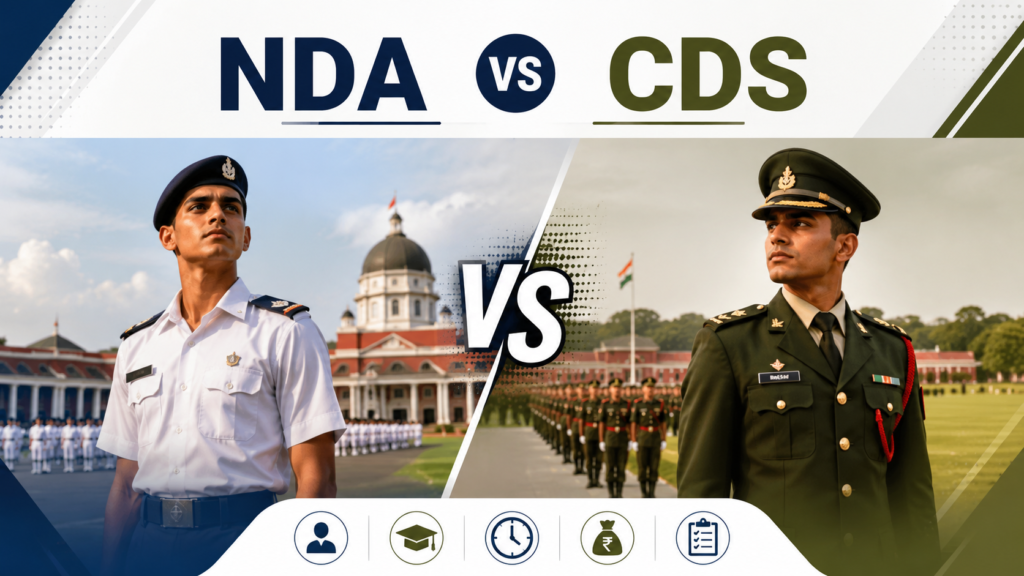
In this detailed comparison of NDA vs CDS, you’ll learn the key differences, eligibility criteria, salary, exam pattern, selection process, advantages, and which exam is better for your career goals.
NDA vs CDS: Quick Comparison
| Feature | NDA | CDS |
|---|---|---|
| Conducting Body | UPSC | UPSC |
| Full Form | National Defence Academy | Combined Defence Services |
| Qualification | 12th Pass | Graduation |
| Age Limit | 16.5–19.5 Years | 19–25 Years (varies by academy) |
| Gender | Male & Female (as per UPSC notification) | Male & Female (academy-wise) |
| Exam Frequency | Twice a Year | Twice a Year |
| Training Academy | NDA, Khadakwasla | IMA, INA, AFA & OTA |
| Selection Process | Written Exam + SSB Interview + Medical | Written Exam + SSB Interview + Medical |
| Entry Level | After Class 12 | After Graduation |
What is NDA?
The National Defence Academy (NDA) is the premier joint defence training academy of India. Students can join immediately after passing Class 12 and receive academic as well as military training before moving to their respective service academies.
Candidates selected through the NDA exam can join:
- Indian Army
- Indian Navy
- Indian Air Force
NDA is ideal for students who dream of serving the nation immediately after school.
What is CDS?
The Combined Defence Services (CDS) Examination is conducted for graduates who wish to become officers in the Indian Armed Forces.
Candidates selected through CDS can join:
- Indian Military Academy (IMA)
- Indian Naval Academy (INA)
- Air Force Academy (AFA)
- Officers Training Academy (OTA)
CDS provides direct officer entry after graduation and is one of the most respected defence examinations in India.
Difference Between NDA and CDS
Educational Qualification
NDA
- Passed Class 12 from a recognized board.
- Physics and Mathematics are required for Air Force and Navy.
- Army Wing accepts students from any stream.
CDS
- Graduation is mandatory.
- Engineering degree is required for certain entries.
- Physics and Mathematics at the graduation or 10+2 level are needed for Air Force and Navy entries.
Age Limit
NDA
- Approximately 16.5 to 19.5 years.
CDS
- Generally between 19 and 25 years, depending on the academy and UPSC notification.
Exam Pattern
NDA Exam Pattern
| Subject | Marks |
|---|---|
| Mathematics | 300 |
| General Ability Test | 600 |
| Total | 900 |
CDS Exam Pattern
For IMA, INA & AFA
| Subject | Marks |
|---|---|
| English | 100 |
| General Knowledge | 100 |
| Elementary Mathematics | 100 |
| Total | 300 |
For OTA
| Subject | Marks |
|---|---|
| English | 100 |
| General Knowledge | 100 |
| Total | 200 |
Selection Process of NDA and CDS
Both examinations follow a similar recruitment process.
- UPSC Written Examination
- SSB Interview
- Medical Examination
- Merit List
- Training
The SSB Interview evaluates leadership, communication skills, intelligence, decision-making ability, and personality.
NDA Training
Candidates selected through NDA undergo approximately three years of training at the National Defence Academy, followed by specialized training at their respective service academies.
The training focuses on:
- Leadership
- Physical fitness
- Military discipline
- Academic education
- Outdoor activities
- Weapon handling
CDS Training
Selected candidates are sent directly to their allotted academies such as:
- Indian Military Academy
- Indian Naval Academy
- Air Force Academy
- Officers Training Academy
Training duration varies according to the academy.
NDA vs CDS Salary
Both NDA and CDS officers receive the salary applicable to commissioned officers in the Indian Armed Forces.
| Particular | NDA | CDS |
|---|---|---|
| Starting Rank | Lieutenant | Lieutenant |
| Basic Pay | ₹56,100 per month | ₹56,100 per month |
| Allowances | Yes | Yes |
| Medical Benefits | Yes | Yes |
| Pension Benefits | As per Government Rules | As per Government Rules |
Apart from salary, officers receive several benefits including: PDF merger tool
- Free accommodation
- Medical facilities
- Military canteen facilities
- Travel concessions
- Uniform allowance
- Insurance benefits
- Career growth opportunities
NDA vs CDS: Which is Tougher?
Both exams are competitive but differ in difficulty.
- NDA requires strong preparation in Mathematics and General Ability after Class 12.
- CDS is designed for graduates and generally has a higher level of English and General Knowledge.
The SSB Interview remains equally challenging in both examinations.
NDA vs CDS: Which is Better?
The answer depends on your educational stage and career goals.
Choose NDA if:
- You have completed Class 12.
- You want to start your defence career early.
- You are passionate about military life from a young age.
Choose CDS if:
- You have completed graduation.
- You want to become an officer after earning a degree.
- You missed the NDA opportunity or decided later to join the Armed Forces.
Neither exam is inherently better—the right choice depends on your eligibility and aspirations.
Advantages of NDA
- Join after Class 12
- Longer leadership development
- Prestigious military training
- Early career growth
- Opportunity to serve in Army, Navy, or Air Force
Advantages of CDS
- Graduation-based entry
- Suitable for graduates from different disciplines
- Direct officer training
- Multiple academy options
- Excellent career prospects
Preparation Tips for NDA and CDS
- Understand the latest UPSC syllabus.
- Follow a daily study schedule.
- Strengthen Mathematics concepts.
- Read newspapers regularly for current affairs.
- Practice previous years’ question papers.
- Attempt mock tests consistently.
- Improve English vocabulary and comprehension.
- Stay physically fit for the SSB Interview and medical examination.
NDA vs CDS: Eligibility at a Glance
| Criteria | NDA | CDS |
|---|---|---|
| Qualification | 12th Pass | Graduation |
| Age | 16.5–19.5 Years | 19–25 Years |
| Exam Level | After School | After College |
| Officer Rank | Yes | Yes |
| SSB Interview | Yes | Yes |
| Medical Test | Yes | Yes |
Frequently Asked Questions (FAQs)
Is NDA better than CDS?
NDA is ideal for students after Class 12, while CDS is meant for graduates. The better option depends on your educational qualification and career timeline.
Can I apply for CDS after NDA?
Yes. If you meet the eligibility conditions after graduation, you can apply for CDS even if you have previously appeared for NDA.
Is the salary of NDA and CDS officers the same?
Yes. After commissioning, officers receive pay according to their rank and applicable government rules.
Which exam is more difficult, NDA or CDS?
Both exams are competitive. NDA emphasizes Mathematics and General Ability, whereas CDS has a stronger focus on English and General Knowledge for graduates.
Can girls apply for NDA and CDS?
Yes. Female candidates can apply for eligible entries according to the latest UPSC notifications and academy-wise eligibility conditions.
Conclusion
When comparing NDA vs CDS, there is no universal winner. NDA is the best route for students who want to join the Armed Forces immediately after Class 12, while CDS is the preferred option for graduates seeking a commission as an officer.
Before applying, carefully check the latest UPSC notification for eligibility, age limits, and academy-specific requirements. Choose the path that matches your qualifications, prepare consistently, and stay committed to your goal of serving the nation.