Choosing the right competitive exam can shape your future career. Every year, millions of students appear for various competitive exams in India to secure admission to prestigious colleges or get government and private sector jobs.
Whether you want to become an IAS officer, engineer, doctor, banker, professor, or lawyer, there is a competitive exam designed for your career path.
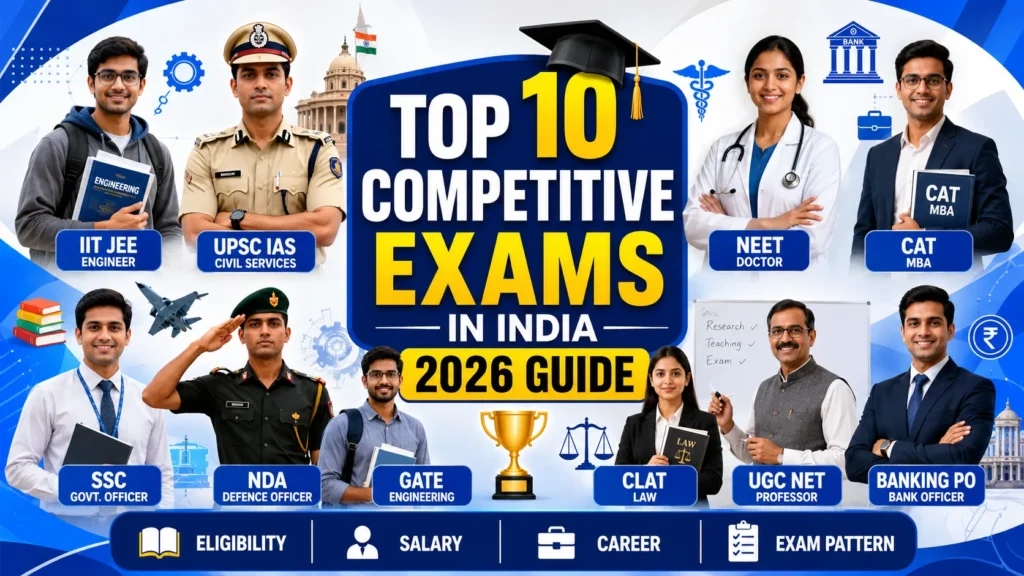
In this detailed guide, we have listed the Top 10 Competitive Exams in India along with their eligibility, conducting authority, exam purpose, difficulty level, salary, and preparation tips.
What Are Competitive Exams?
Competitive exams are standardized tests conducted by government bodies, universities, or recruitment agencies to select the most deserving candidates for admissions or jobs.
These exams evaluate candidates based on subjects like:
- General Knowledge
- Mathematics
- Logical Reasoning
- English
- Subject-specific knowledge
- Aptitude
Because lakhs of candidates compete for limited seats or vacancies, these exams are called competitive examinations.
Top 10 Competitive Exams in India (2026)
| Rank | Exam Name | Conducting Body | Purpose |
|---|---|---|---|
| 1 | UPSC Civil Services Examination | UPSC | IAS, IPS, IFS |
| 2 | IIT JEE (Main & Advanced) | NTA & IITs | Engineering Admission |
| 3 | NEET UG | NTA | Medical Admission |
| 4 | CAT | IIMs | MBA Admission |
| 5 | SSC CGL | Staff Selection Commission | Central Government Jobs |
| 6 | NDA | UPSC | Indian Armed Forces |
| 7 | GATE | IISc & IITs | M.Tech & PSU Recruitment |
| 8 | CLAT | Consortium of NLUs | Law Admission |
| 9 | UGC NET | National Testing Agency | Assistant Professor & JRF |
| 10 | IBPS PO / SBI PO | IBPS & SBI | Banking Jobs |
1. UPSC Civil Services Examination (CSE)
The UPSC Civil Services Examination is considered the toughest and most prestigious competitive exam in India.
Highlights
- Conducting Body: Union Public Service Commission (UPSC)
- Qualification: Graduation
- Age Limit: 21–32 Years (General)
- Exam Levels:
- Preliminary Exam
- Main Examination
- Personality Test (Interview)
Career Opportunities
Successful candidates can become:
- IAS Officer
- IPS Officer
- IFS Officer
- IRS Officer
Expected Salary
₹56,100 to ₹2,50,000+ per month (depending on post and level).
2. IIT JEE (Main & Advanced)
JEE is India’s premier engineering entrance examination.
Eligibility
- 12th with Physics, Chemistry, and Mathematics
- Conducted after Class 12
Courses Offered
- B.Tech
- B.E.
- Integrated Programs
Top Institutes
- IITs
- NITs
- IIITs
- GFTIs
Difficulty Level
Very High
3. NEET UG
NEET is the only national-level medical entrance examination in India. JPG to PDF converter
Eligibility
- Class 12 with PCB
- Minimum qualifying marks as prescribed
Courses
- MBBS
- BDS
- BAMS
- BHMS
- Veterinary Courses
- Nursing Courses
Difficulty Level
High
4. CAT (Common Admission Test)
CAT is conducted every year for admission into India’s top management institutes.
Eligibility
- Bachelor’s Degree
- Final-year students can also apply
Top Colleges
- IIM Ahmedabad
- IIM Bangalore
- IIM Calcutta
- Other Top B-Schools
Subjects
- Quantitative Aptitude
- Logical Reasoning
- Data Interpretation
- Verbal Ability
5. SSC CGL
SSC Combined Graduate Level Examination recruits graduates for various Central Government departments.
Popular Posts
- Income Tax Inspector
- CBI Inspector
- Assistant Section Officer
- Auditor
- Excise Inspector
Eligibility
Graduation from a recognized university.
Salary
₹35,000–₹1,00,000+ per month depending on post.
6. NDA Examination
The National Defence Academy Examination is conducted by UPSC.
Eligibility
- 12th Pass
- PCM required for Air Force and Navy
Career
Candidates join:
- Indian Army
- Indian Navy
- Indian Air Force
Selection Process
- Written Examination
- SSB Interview
- Medical Test
7. GATE
Graduate Aptitude Test in Engineering is one of India’s most important postgraduate entrance examinations.
Eligibility
- Engineering Graduation
- Final-year Engineering Students
Benefits
- M.Tech Admission
- PSU Recruitment
- Research Opportunities
- Higher Studies Abroad
8. CLAT
CLAT is the national entrance examination for law admissions.
Courses
- BA LLB
- BBA LLB
- LLM
Eligibility
12th Pass (UG)
Top Colleges
National Law Universities (NLUs)
9. UGC NET
UGC NET determines eligibility for Assistant Professor and Junior Research Fellowship (JRF).
Eligibility
Master’s Degree
Career Options
- Assistant Professor
- Research Scholar
- PhD Opportunities
10. Banking Exams (IBPS PO & SBI PO)
Banking exams are among the most popular government job examinations in India.
Eligibility
Graduation
Selection Process
- Preliminary Exam
- Main Exam
- Interview (where applicable)
Salary
₹52,000–₹75,000+ per month (including allowances).
Comparison of Top Competitive Exams in India
| Exam | Qualification | Career | Difficulty |
|---|---|---|---|
| UPSC | Graduation | Civil Services | Very High |
| IIT JEE | 12th PCM | Engineer | Very High |
| NEET | 12th PCB | Doctor | Very High |
| CAT | Graduation | MBA | High |
| SSC CGL | Graduation | Government Jobs | Moderate to High |
| NDA | 12th | Defence Officer | High |
| GATE | Engineering | M.Tech/PSU | High |
| CLAT | 12th | Lawyer | Moderate |
| UGC NET | Master’s | Professor | Moderate to High |
| IBPS PO | Graduation | Banking Officer | Moderate |
How to Choose the Right Competitive Exam?
Selecting the right exam depends on your educational background, interests, and long-term career goals.
Consider the following before applying:
- Your educational qualification.
- Career aspirations.
- Difficulty level of the exam.
- Job security and growth opportunities.
- Salary expectations.
- Personal interests and strengths.
Choosing an exam aligned with your passion increases your chances of success.
Best Preparation Tips for Competitive Exams
Follow these proven strategies to improve your preparation:
- Understand the latest syllabus thoroughly.
- Study the official exam pattern.
- Create a realistic study timetable.
- Practice previous year question papers.
- Solve mock tests regularly.
- Improve time management skills.
- Read newspapers daily for current affairs.
- Revise important topics consistently.
- Focus on accuracy as well as speed.
- Maintain good physical and mental health during preparation.
Benefits of Clearing Competitive Exams
Cracking a competitive exam offers several advantages:
- Secure and stable career.
- Attractive salary packages.
- Government benefits and allowances.
- Respect and social recognition.
- Opportunities for career growth.
- Job satisfaction and financial security.
Frequently Asked Questions (FAQs)
Which is the toughest competitive exam in India?
The UPSC Civil Services Examination is widely regarded as the toughest competitive exam in India due to its vast syllabus, multi-stage selection process, and low success rate.
Which competitive exam offers the highest salary?
UPSC Civil Services, especially IAS, IFS, and IPS positions, offer some of the highest salaries and benefits in the government sector.
Can I appear for competitive exams after 12th?
Yes. Exams such as JEE, NEET, NDA, and CLAT are open to students who have completed Class 12, subject to eligibility criteria.
Which competitive exam is best for engineering students?
Engineering students often choose IIT JEE (before graduation), GATE (after graduation), SSC CGL, UPSC, and various PSU recruitment exams.
Which exam is best for government jobs after graduation?
UPSC CSE, SSC CGL, IBPS PO, SBI PO, RBI Grade B, and State PSC exams are among the best options for graduates seeking government jobs.
Conclusion
India offers numerous competitive examinations that can lead to rewarding careers in engineering, medicine, civil services, law, banking, defence, management, and academia. Before choosing an exam, evaluate your interests, qualifications, and long-term goals. Consistent preparation, disciplined study habits, and regular practice are the keys to success.
Whether your dream is to become an IAS officer, doctor, engineer, banker, professor, or lawyer, selecting the right competitive exam and preparing strategically can help you achieve your career aspirations.