The Indian Revenue Service (IRS) is one of the most prestigious civil services in India. IRS officers play a crucial role in tax administration, revenue collection, and financial law enforcement. Every year, thousands of aspirants prepare for the UPSC Civil Services Examination with the dream of becoming an IRS officer.
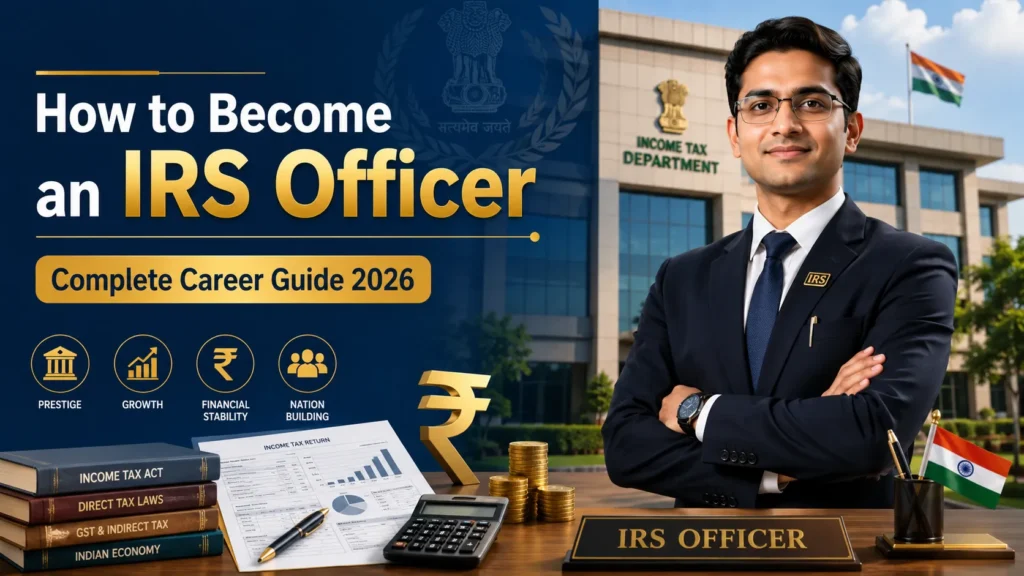
If you are wondering how to become an IRS officer, this comprehensive guide covers eligibility criteria, educational qualifications, age limits, selection process, salary, training, job responsibilities, and career growth opportunities.
What Is an IRS Officer?
An IRS (Indian Revenue Service) officer is a Group A civil servant responsible for administering direct and indirect taxes in India. IRS officers work under the Ministry of Finance and are primarily involved in tax collection, investigation of tax evasion, financial compliance, and revenue administration.
The IRS is divided into two major branches:
- IRS (Income Tax)
- IRS (Customs and Indirect Taxes)
Both branches are recruited through the UPSC Civil Services Examination (CSE).
Why Choose a Career as an IRS Officer?
Becoming an IRS officer offers numerous benefits, including:
- Prestigious government position
- Attractive salary and allowances
- Job security
- Opportunities to serve the nation
- Work-life balance compared to some other civil services
- Exposure to financial investigations and taxation laws
- Career growth and promotions
Eligibility Criteria to Become an IRS Officer
Candidates must fulfill specific eligibility requirements before applying for the UPSC Civil Services Examination.
Educational Qualification
To become an IRS officer, candidates must:
- Hold a bachelor’s degree from a recognized university.
- Final-year students can also apply provisionally.
- Candidates from any stream such as Arts, Science, Commerce, Engineering, or Medicine are eligible.
Age Limit
The age requirements are:
| Category | Age Limit |
|---|---|
| General | 21 to 32 Years |
| OBC | Up to 35 Years |
| SC/ST | Up to 37 Years |
| PwBD | Additional Relaxation as per UPSC Rules |
Nationality
The applicant must be:
- A citizen of India, or
- Eligible under UPSC nationality guidelines.
How to Become an IRS Officer Through UPSC
The only way to become an IRS officer is by clearing the UPSC Civil Services Examination.
Step 1: Complete Your Graduation
The first step is earning a bachelor’s degree from a recognized institution. Your academic discipline does not matter as long as you meet UPSC eligibility requirements.
Step 2: Apply for UPSC Civil Services Examination
Every year, the Union Public Service Commission (UPSC) releases the Civil Services Examination notification. Eligible candidates can apply online through the official UPSC website.
Step 3: Clear the UPSC Preliminary Examination
The Preliminary Examination consists of:
General Studies Paper I
Topics include:
- History
- Geography
- Polity
- Economics
- Environment
- Current Affairs
- Science and Technology
CSAT Paper II
Topics include:
- Logical Reasoning
- Quantitative Aptitude
- Reading Comprehension
- Decision Making
Only candidates who qualify for the prelims can appear for the mains examination.
Step 4: Clear the UPSC Mains Examination
The Mains Examination consists of:
- Essay Paper
- General Studies Papers
- Optional Subject Papers
- Language Papers
The mains exam tests analytical ability, subject knowledge, writing skills, and decision-making capabilities.
Step 5: Appear for the UPSC Interview
Candidates who clear the mains examination are called for the Personality Test (Interview).
The interview assesses:
- Communication skills
- Leadership qualities
- General awareness
- Administrative aptitude
- Decision-making ability
Step 6: Secure a Rank for IRS Allocation
After the interview, UPSC prepares the final merit list.
Candidates who achieve the required rank and preference can be allocated to:
- IRS (Income Tax)
- IRS (Customs and Indirect Taxes)
The required rank varies every year depending on vacancies and competition.
IRS Officer Training
After selection, IRS officers undergo professional training.
IRS (Income Tax) Training
Training is conducted at:
National Academy of Direct Taxes (NADT), Nagpur.
Training modules include:
- Income Tax Laws
- Investigation Techniques
- Financial Analysis
- Information Technology
- Administrative Procedures
IRS (Customs and Indirect Taxes) Training
Training is conducted at:
National Academy of Customs, Indirect Taxes and Narcotics (NACIN).
Training focuses on:
- Customs Laws
- GST Administration
- Anti-Smuggling Operations
- Financial Intelligence
Roles and Responsibilities of an IRS Officer
An IRS officer performs various important duties.
Tax Administration
- Collection of taxes
- Monitoring tax compliance
- Tax assessment procedures
Investigation and Enforcement
- Detecting tax evasion
- Conducting raids and searches
- Financial crime investigations
Policy Implementation
- Executing tax policies
- Revenue management
- Supporting economic reforms
Public Service
- Assisting taxpayers
- Resolving disputes
- Promoting voluntary tax compliance
IRS Officer Salary in India
The salary of an IRS officer is based on the 7th Pay Commission.
Entry-Level Salary
An Assistant Commissioner or Assistant Director generally receives:
- Basic Pay: ₹56,100 per month
- Dearness Allowance (DA)
- House Rent Allowance (HRA)
- Travel Allowance (TA)
- Other government benefits
The total monthly salary can range between ₹80,000 and ₹1,20,000 depending on location and allowances.
Career Growth of an IRS Officer
The promotion hierarchy typically includes:
- Assistant Commissioner
- Deputy Commissioner
- Joint Commissioner
- Additional Commissioner
- Commissioner
- Principal Commissioner
- Chief Commissioner
- Principal Chief Commissioner
With experience and performance, officers can rise to top administrative positions within the tax department.
Skills Required to Become an IRS Officer
Successful IRS officers usually possess:
- Strong analytical skills
- Problem-solving ability
- Leadership qualities
- Communication skills
- Knowledge of finance and taxation
- Integrity and professionalism
- Decision-making capability
Preparation Tips for IRS Aspirants
Understand the UPSC Syllabus
Carefully study the latest UPSC syllabus and exam pattern.
Build Strong Fundamentals
Focus on:
- Indian Polity
- Economy
- History
- Geography
- Current Affairs
Read Newspapers Daily
Regular reading improves awareness of: make PDF smaller
- Government policies
- Economic developments
- International affairs
Practice Answer Writing
Consistent answer writing improves:
- Speed
- Clarity
- Presentation
Take Mock Tests
Mock tests help evaluate preparation levels and identify weaknesses.
Challenges Faced by IRS Officers
While the profession is rewarding, it also comes with challenges:
- Handling complex tax cases
- Investigating financial fraud
- Managing large workloads during assessment periods
- Keeping up with changing tax laws and regulations
However, these challenges contribute to professional growth and expertise.
Conclusion
Becoming an IRS officer is a prestigious career goal that requires dedication, discipline, and consistent preparation. The journey begins with graduation and culminates in successfully clearing the UPSC Civil Services Examination. IRS officers play a vital role in India’s financial administration, tax enforcement, and economic development.
If you aspire to serve the nation while building a respected and stable career, the Indian Revenue Service offers excellent opportunities for professional growth, public service, and leadership.