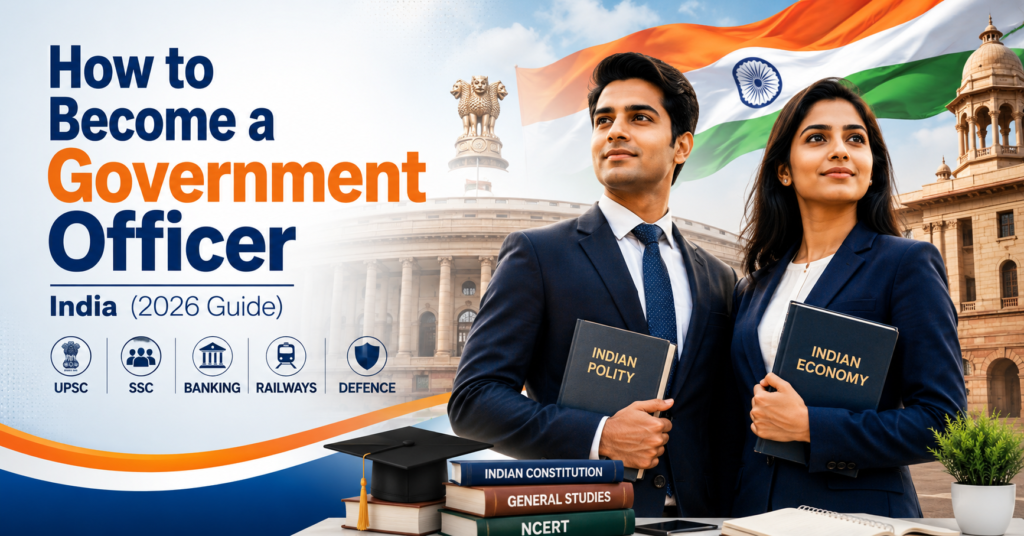
Becoming a government officer is one of the most popular career goals among Indian students. Every year, millions of candidates prepare for government examinations to secure prestigious positions in central and state government departments. Government officers enjoy job security, competitive salaries, career growth, social respect, and the opportunity to contribute to the country’s development.
Whether you aspire to become an IAS Officer, IPS Officer, Income Tax Officer, Bank PO, Railway Officer, or a State Government Officer, the path begins with understanding the eligibility criteria, choosing the right examination, and preparing strategically.
In this comprehensive guide, you’ll learn everything about how to become a government officer in India, including eligibility, qualifications, age limit, top exams, salary, preparation strategy, and frequently asked questions.
Table of Contents
- What is a Government Officer?
- Why Become a Government Officer?
- Eligibility to Become a Government Officer
- Educational Qualification Required
- Top Government Officer Exams in India
- Step-by-Step Process to Become a Government Officer
- Essential Skills Required
- Government Officer Salary in India
- Best Books for Preparation
- Preparation Tips
- Career Growth
- Challenges
- Frequently Asked Questions
- Conclusion
What is a Government Officer?
A government officer is an individual employed by the Central Government, State Government, or a government organization to perform administrative, financial, technical, law enforcement, judicial, or public service responsibilities.
Government officers play a vital role in implementing government policies, maintaining law and order, managing public welfare schemes, collecting taxes, supervising departments, and ensuring the smooth functioning of public administration.
Some of the most popular government officer posts include:
- IAS Officer
- IPS Officer
- IFS Officer
- IRS Officer
- Income Tax Officer
- Assistant Section Officer
- Bank Probationary Officer (PO)
- Railway Officer
- Commercial Tax Officer
- Block Development Officer (BDO)
- Deputy Collector
- DSP (Deputy Superintendent of Police)
Why Become a Government Officer?
A government job is considered one of the most secure and respected career options in India.
Some major benefits include:
- Excellent job security
- Attractive salary packages
- Dearness Allowance (DA)
- House Rent Allowance (HRA)
- Medical facilities
- Pension and retirement benefits (as per applicable rules)
- Paid holidays and leave benefits
- Promotion opportunities
- Social recognition
- Better work-life balance in many departments
- Opportunity to serve society and the nation
These advantages make government officer positions highly competitive.
Eligibility to Become a Government Officer
The eligibility criteria vary depending on the recruitment examination and department. However, the general requirements are as follows.
| Criteria | Requirement |
|---|---|
| Nationality | Indian Citizen |
| Qualification | Graduation (for most officer posts) |
| Age Limit | Generally 21–32 years |
| Physical Standards | Required for police and defence services |
| Character | Good moral character |
Candidates belonging to SC, ST, OBC, EWS, and other reserved categories receive age relaxation according to government rules.
Educational Qualification Required
Educational qualification depends on the officer post you want to apply for.
After 10th
Several government departments recruit candidates after Class 10 for entry-level positions.
Popular opportunities include:
- Railway Recruitment
- Forest Guard
- Multi-Tasking Staff (MTS)
- Police Constable
- Defence Support Staff
Although these are generally not officer-level posts, they can help candidates build a government career.
After 12th
Students who have completed Class 12 can apply for several competitive examinations.
Popular options include:
- SSC CHSL
- NDA
- Indian Navy
- Indian Air Force
- State Police Recruitment
Some departments also offer promotional opportunities to officer-level positions after gaining experience.
After Graduation
Graduation is the minimum qualification for most government officer posts.
Accepted degrees include:
- BA
- BSc
- BCom
- BBA
- BCA
- BTech
- LLB
- MBBS
- Any recognized Bachelor’s Degree
The stream of graduation usually does not matter unless a technical qualification is specifically required.
Top Government Officer Exams in India
Several competitive examinations recruit candidates for officer-level positions.
UPSC Civil Services Examination
The UPSC Civil Services Examination is one of the toughest competitive exams in India.
Through this examination, candidates can become:
- IAS Officer
- IPS Officer
- IFS Officer
- IRS Officer
- IAAS Officer
Selection Process:
- Preliminary Examination
- Main Examination
- Personality Test (Interview)
SSC CGL
SSC Combined Graduate Level (SSC CGL) recruits officers for various Central Government departments.
Popular posts include: join multiple PDFs
- Income Tax Inspector
- Assistant Section Officer
- CBI Sub-Inspector
- Excise Inspector
- Auditor
- Assistant Enforcement Officer
Graduation is mandatory.
IBPS PO
IBPS PO recruits Probationary Officers for Public Sector Banks.
Selected candidates undergo training before being posted as Bank Officers.
SBI PO
State Bank of India conducts SBI PO recruitment every year.
It offers one of the highest salaries among banking jobs.
State PSC Examinations
Every state conducts Public Service Commission examinations.
Examples include:
- UPPSC
- BPSC
- MPPSC
- RPSC
- HPSC
- UKPSC
- JPSC
Popular posts:
- Deputy Collector
- DSP
- Commercial Tax Officer
- Block Development Officer
- Tehsildar
Railway Officer Recruitment
Railways recruit officers through various examinations conducted by the Railway Recruitment Boards (RRBs) and other recruitment agencies.
Popular departments include:
- Traffic
- Engineering
- Operations
- Accounts
- Personnel
Defence Officer Examinations
Candidates interested in serving the country through the armed forces can appear for:
- NDA
- CDS
- AFCAT
- Technical Entry Schemes
Successful candidates become officers in the Indian Army, Navy, or Air Force.
Step-by-Step Process to Become a Government Officer
Following a structured approach significantly improves your chances of success.
Step 1: Complete Your Education
Finish your graduation from a recognized university. Most officer-level examinations require a bachelor’s degree.
Step 2: Choose the Right Examination
Select an examination based on your career goals.
Examples:
- IAS → UPSC
- Income Tax Officer → SSC CGL
- Bank Officer → IBPS PO / SBI PO
- State Administrative Officer → State PSC
- Railway Officer → RRB Recruitment
Avoid preparing for multiple unrelated examinations simultaneously.
Step 3: Understand the Syllabus
Download the latest syllabus and exam pattern.
Analyze:
- Subjects
- Marking Scheme
- Negative Marking
- Previous Year Papers
Knowing the syllabus prevents wasting time on irrelevant topics.
Step 4: Create a Study Plan
Prepare a realistic timetable.
Your study schedule should include:
- Current Affairs
- General Knowledge
- Quantitative Aptitude
- English
- Logical Reasoning
- Computer Awareness
- Subject-Specific Topics
Consistency is more important than studying for long hours occasionally.
Step 5: Practice Mock Tests
Mock tests improve:
- Speed
- Accuracy
- Confidence
- Time Management
Attempt at least one full-length mock test every week during the early stages and increase the frequency as the exam approaches.
Step 6: Revise Regularly
Revision is essential for long-term retention.
A simple strategy is:
- Daily Revision
- Weekly Revision
- Monthly Revision
Keep short notes for quick revision before the examination.
Step 7: Clear the Selection Process
Most government officer recruitments include multiple stages such as:
- Preliminary Examination
- Main Examination
- Skill Test (if applicable)
- Interview
- Document Verification
- Medical Examination (for specific services)
Successfully clearing all stages leads to final selection.
Essential Skills Required to Become a Government Officer
Apart from academic preparation, candidates should develop the following skills:
- Leadership
- Communication Skills
- Decision-Making Ability
- Time Management
- Problem-Solving Skills
- Analytical Thinking
- Ethics and Integrity
- Public Administration Awareness
- Emotional Intelligence
- Teamwork
These skills are valuable during interviews as well as throughout your career.
Government Officer Salary in India
The salary varies depending on the department, pay level, and post.
| Officer Post | Average Monthly Salary |
|---|---|
| IAS Officer | ₹56,100 – ₹2,50,000+ |
| IPS Officer | ₹56,100 – ₹2,25,000+ |
| Income Tax Officer | ₹44,900 – ₹1,42,400 |
| Assistant Section Officer | ₹44,900 – ₹1,42,400 |
| Bank PO | ₹52,000 – ₹70,000 |
| State PSC Officer | ₹45,000 – ₹1,20,000+ |
In addition to the basic salary, officers may receive:
- Dearness Allowance (DA)
- House Rent Allowance (HRA)
- Travel Allowance (TA)
- Medical Benefits
- Government Accommodation (for eligible posts)
- Leave Travel Concession (LTC)
- Retirement Benefits
Best Books for Government Officer Preparation
The following books are widely recommended by successful candidates:
- Lucent’s General Knowledge
- NCERT Books (Class 6–12)
- Indian Polity by M. Laxmikanth
- Spectrum Modern History
- RS Aggarwal Quantitative Aptitude
- RS Aggarwal Verbal & Non-Verbal Reasoning
- Wren & Martin High School English Grammar
- Daily Newspaper (The Hindu or The Indian Express)
Choose a limited set of reliable books and revise them thoroughly instead of collecting too many study materials.
Preparation Tips to Crack Government Officer Exams
Here are some effective preparation tips:
- Select one target examination at a time.
- Follow the official syllabus.
- Read newspapers regularly.
- Solve previous years’ question papers.
- Take mock tests consistently.
- Make concise revision notes.
- Improve your weak subjects first.
- Stay updated with current affairs.
- Maintain discipline and consistency.
- Take care of your physical and mental health.
Success in government exams depends more on consistent preparation than on studying for extremely long hours.
Career Growth of a Government Officer
Government officers receive promotions based on seniority, departmental examinations, and performance.
For example:
- Assistant Section Officer → Section Officer → Under Secretary → Deputy Secretary → Director
- Bank PO → Assistant Manager → Branch Manager → Regional Manager → General Manager
- IAS Officer → District Magistrate → Divisional Commissioner → Principal Secretary → Chief Secretary
Career progression differs across departments but generally offers excellent long-term growth.
Challenges of Becoming a Government Officer
While government jobs offer numerous benefits, candidates should also be aware of the challenges.
Some common challenges include:
- Intense competition
- Limited vacancies
- Long preparation period
- Extensive syllabus
- Multi-stage selection process
- High cutoff marks
- Pressure during interviews
Understanding these challenges helps candidates prepare with realistic expectations.
Frequently Asked Questions (FAQs)
Can I become a government officer after the 12th?
Yes, you can apply for certain government examinations after Class 12, such as NDA and SSC CHSL. However, most officer-level positions require a bachelor’s degree.
Which degree is best for becoming a government officer?
There is no single best degree. Candidates with BA, BCom, BSc, BTech, BBA, BCA, LLB, MBBS, and other recognized bachelor’s degrees are eligible for many government officer examinations.
What is the age limit for becoming a government officer?
The age limit generally ranges from 21 to 32 years for many competitive examinations. Age relaxation is provided to reserved category candidates according to government norms.
Which government officer exam is the toughest?
The UPSC Civil Services Examination is considered one of the toughest government recruitment exams in India due to its comprehensive syllabus and highly competitive selection process.
How long does it take to become a government officer?
The preparation time varies for each candidate. On average, dedicated preparation for 1–3 years is common before securing selection.
Can final-year students apply for government officer exams?
Yes. Many examinations allow final-year students to apply, provided they complete their degree before the specified deadline for document verification.
Conclusion
Becoming a government officer is a rewarding career choice for candidates who are committed to hard work, discipline, and continuous learning. Whether your goal is to join the civil services, banking sector, railways, defence, or state administration, success depends on choosing the right examination, understanding the syllabus, and following a consistent preparation strategy.
Start your preparation early, stay focused on your goal, and regularly practice mock tests while revising important topics. With determination and the right approach, you can successfully achieve your dream of becoming a government officer and build a stable, respected, and impactful career in public service.