Quick Overview
JEE is one of India’s most popular engineering entrance examinations.
Every year, lakhs of students appear for JEE to secure admission into top engineering colleges, including IITs, NITs, IIITs, and other prestigious institutions.
Through JEE, students can pursue careers in: divide PDF file
- Engineering
- Technology
- Computer Science
- Artificial Intelligence
- Data Science
- Mechanical Engineering
- Civil Engineering
In this article, we will cover:
- JEE Full Form
- What is JEE?
- Eligibility criteria
- Exam pattern
- JEE Main vs JEE Advanced
- Career opportunities
- Preparation tips
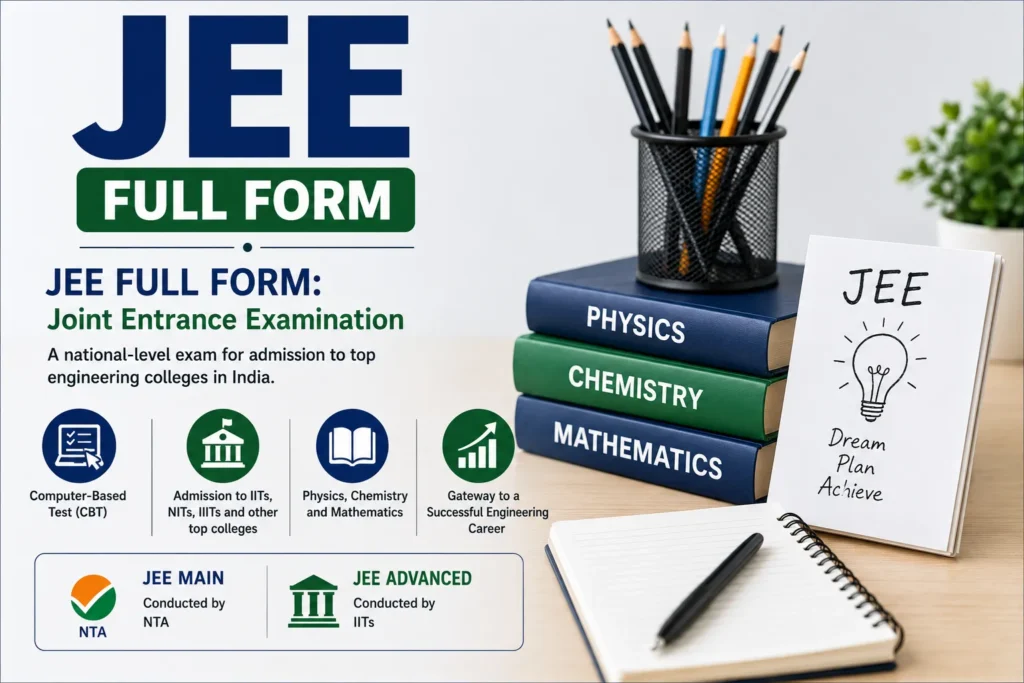
JEE Full Form
JEE Full Form: Joint Entrance Examination
JEE is a national-level engineering entrance examination conducted for admission to undergraduate engineering programs in India.
What Is JEE?
JEE is the gateway to some of India’s best engineering colleges.
The examination is divided into two stages:
- JEE Main
- JEE Advanced
Students generally appear for JEE Main first, and top-performing candidates become eligible for JEE Advanced.
Who Conducts JEE?
JEE Main
Conducted by:
National Testing Agency (NTA)
JEE Advanced
Conducted by:
One of the Indian Institutes of Technology (IITs) on a rotational basis.
Why Is JEE Important?
JEE helps students gain admission to:
- IITs (Indian Institutes of Technology)
- NITs (National Institutes of Technology)
- IIITs (Indian Institutes of Information Technology)
- Government Engineering Colleges
- Private Engineering Institutions
JEE Eligibility Criteria
Educational Qualification
Candidates should have:
- Passed Class 12 (10+2)
- OR be appearing in Class 12
with subjects including:
- Physics
- Chemistry
- Mathematics
Age Limit
Generally, there is no strict age limit for JEE Main, subject to current eligibility rules.
Candidates should always verify the latest official notification.
JEE Main Exam Pattern
JEE Main evaluates candidates on:
| Subject | Marks Weightage |
|---|---|
| Physics | High |
| Chemistry | High |
| Mathematics | High |
The examination is conducted in Computer-Based Test (CBT) mode.
JEE Advanced
JEE Advanced is the second stage of the JEE process.
Only candidates who qualify in JEE Main can appear for JEE Advanced.
Purpose
Admission to:
- IIT Bombay
- IIT Delhi
- IIT Madras
- IIT Kanpur
- IIT Kharagpur
- Other IITs
Difference Between JEE Main and JEE Advanced
| Feature | JEE Main | JEE Advanced |
|---|---|---|
| Conducting Body | NTA | IIT |
| Difficulty Level | Moderate | Very High |
| Admission | NITs, IIITs | IITs |
| Eligibility | 12th Pass | Qualified JEE Main |
Subjects in JEE
Physics
Topics include:
- Mechanics
- Electricity
- Magnetism
- Optics
- Modern Physics
Chemistry
Topics include:
- Organic Chemistry
- Physical Chemistry
- Inorganic Chemistry
Mathematics
Topics include:
- Algebra
- Calculus
- Trigonometry
- Coordinate Geometry
Popular Engineering Courses After JEE
Computer Science Engineering (CSE)
One of the most popular branches.
Artificial Intelligence & Machine Learning
Growing rapidly due to industry demand.
Mechanical Engineering
Core engineering discipline.
Civil Engineering
Focuses on infrastructure and construction.
Electrical Engineering
Covers electrical systems and technology.
Career Opportunities After JEE
Software Engineer
Work in technology and IT companies.
Data Scientist
Analyze and interpret data for organizations.
AI Engineer
Develop Artificial Intelligence solutions.
Mechanical Engineer
Work in manufacturing and industrial sectors.
Civil Engineer
Design and manage infrastructure projects.
Salary After Engineering
Salary depends on:
- College
- Skills
- Branch
- Experience
Fresh Graduates
₹4 LPA – ₹12 LPA+ (varies widely)
Top IIT graduates may receive significantly higher packages.
Benefits of Cracking JEE
Admission to Top Colleges
Access to India’s leading engineering institutions.
Better Career Opportunities
Strong placement prospects.
High Salary Potential
Engineering and technology fields offer excellent earning opportunities.
Industry Recognition
Top colleges enhance career growth.
Is JEE Difficult?
Yes.
JEE is considered one of the toughest entrance examinations in India.
Success requires:
- Strong concepts
- Daily practice
- Time management
- Consistent revision
- Mock test practice
Preparation Tips for JEE
Strengthen Fundamentals
Focus on NCERT concepts first.
Practice Regularly
Problem-solving is critical.
Solve Previous Year Papers
Understand question patterns.
Take Mock Tests
Improve speed and accuracy.
Common Mistakes Students Make
- Ignoring NCERT books
- Weak revision habits
- Lack of mock test practice
- Focusing only on difficult questions
- Poor time management
FAQs
What is the full form of JEE?
JEE stands for Joint Entrance Examination.
Who conducts JEE Main?
JEE Main is conducted by the National Testing Agency (NTA).
Is JEE required for IIT admission?
Yes, candidates must qualify JEE Advanced after JEE Main to gain admission to IITs.
Can 12th-pass students apply for JEE?
Yes, eligible students with Physics, Chemistry, and Mathematics can apply.
Conclusion
JEE stands for Joint Entrance Examination, India’s most important engineering entrance exam.
For students who dream of studying at IITs, NITs, and other top engineering colleges, JEE serves as the gateway to excellent educational and career opportunities.
With disciplined preparation, concept clarity, and consistent practice, students can significantly improve their chances of success.